MYOFASCIAL FACIAL YOGA
Facial yoga works on both the muscles and the skin. Myofascial massage goes deeper — it targets the fascia, the connective tissues that hold muscular tension in place and contribute to the formation of wrinkles.
You may already have tried facial yoga exercises without seeing visible results. It’s not always a question of consistency — often, it’s a question of depth. After more than a year of searching for an approach that truly worked, myofascial work was the only method that genuinely changed my wrinkles. That is what I teach today.
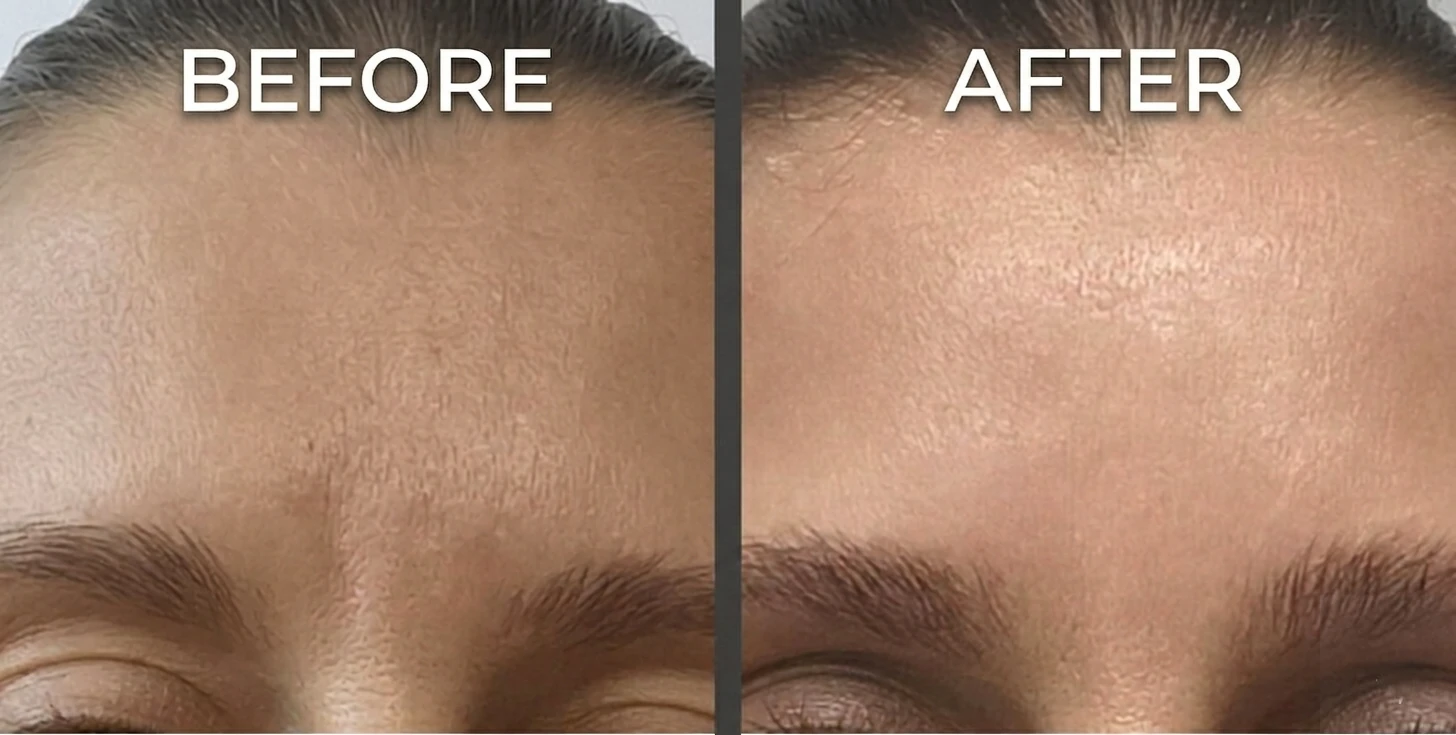
Here is the result after 1 month of facial yoga combined with targeted work on the fascia. Honestly, I surprised myself — after more than a year of trying different methods, it was the first time I saw a real change.
That was when I realised that deeper work on the fascia could genuinely release certain facial tensions — the ones involved in the formation of some wrinkles.
To understand how I arrived at this approach, we need to go back a little.
For more than a year, I tried different facial yoga techniques, massage methods and exercises, both in France and abroad. Each time, I practised seriously, every day for several months before moving on to a new method, convinced it would eventually work. But the wrinkle remained. Sometimes, it even felt as though the tension between my eyebrows was becoming stronger.
I then discovered deeper work on the fascia. The approach was completely different from anything I had tried before. It was no longer simply about massaging the area between the eyebrows or stimulating the muscle responsible for the wrinkle, but about releasing deeper tension within the tissues and understanding which areas of the face were truly involved in that contraction — sometimes even higher up, at the level of the scalp.
Gradually, the tissues started to regain mobility and the area between my eyebrows began to relax. It did not happen overnight, but over the weeks the release became visible and my wrinkle progressively softened.
That is when I understood something important: the solution was not to multiply exercises to relax the muscle, nor to focus only on the area where the wrinkle appears. To create real change, the work had to go deeper — at the level of the fascia, where tension settles and remains.
Since then, this understanding has guided my entire practice and the approach I now share.
There are now many different approaches to facial yoga. Some focus on strengthening the muscles, while others emphasise relaxation, circulation, or improving the skin’s glow. These methods can bring visible benefits, particularly for skin tone and overall skin quality. However, depending on the tension patterns within the face, they do not always address the deeper tissues involved in the formation of certain wrinkles. Understanding these different approaches helps you choose facial yoga exercises that are better suited to your face and its specific needs.
Facial gymnastics, often associated with facial yoga, are based on exercises designed to stimulate and strengthen the facial muscles.
This approach can work well as a preventive method, when tension is still relatively mild and the tissues retain good elasticity.
However, over time, certain areas of the face can become more contracted. In these cases, stimulating the muscle further is not always enough to release the underlying tension, and the results may remain limited. This is something I personally experienced, especially with my frown line.
Some facial yoga approaches rely on massage techniques, particularly lymphatic drainage, to stimulate blood and lymphatic circulation and improve the skin’s appearance.
Through gentle and repetitive movements, these methods aim to boost microcirculation, encourage tissue drainage, and give the complexion a fresher, more radiant appearance.
They can provide a real sense of relaxation and visibly improve skin radiance. However, their action often remains relatively superficial. While this may be enough in some cases, it tends to be more limited when deeper tension patterns are involved — especially within the fascia.
Myofascial facial yoga is based on deeper work on the fascia — the connective tissues that surround the muscles and connect the different structures of the face.
Rather than focusing only on the muscle or the surface of the skin, this approach aims to release deeper tension stored within the tissues and restore mobility throughout the face.
By working on these deeper tension patterns, it becomes possible to relax certain areas more sustainably and soften some wrinkles in a more targeted and coherent way.
It is also the approach through which I personally noticed a real change in my wrinkles.
Today, there are countless facial yoga exercises designed to reduce wrinkles. Some focus on strengthening the muscles, others on stimulating circulation or relaxing certain areas of the face. But in practice, not every exercise is suitable for every face.
I learned this the hard way. For more than a year, I practised different methods and techniques seriously and consistently. Yet not only did my wrinkles fail to improve, I sometimes even reinforced certain imbalances — especially around my frown line.
Looking back, I realised I was not working on the right areas. I massaged the space between my eyebrows every day, while the tension behind my frown line was actually coming from the scalp. I also worked on my jawline, thinking sagging was the issue, when part of the problem was linked to posture and tension in my neck. And most importantly, I was not working deeply enough. I was stimulating the muscles and massaging the skin, but the fascia — those deeper tissues that hold tension in place — remained rigid. The tension kept returning.
The problem does not come from the exercises themselves. It comes from practising them without understanding the true origin of the tension, and without reaching the deeper layer where it is actually maintained.
That is exactly what the facial assessment is for — understanding where your tension comes from and which areas should be worked on first.
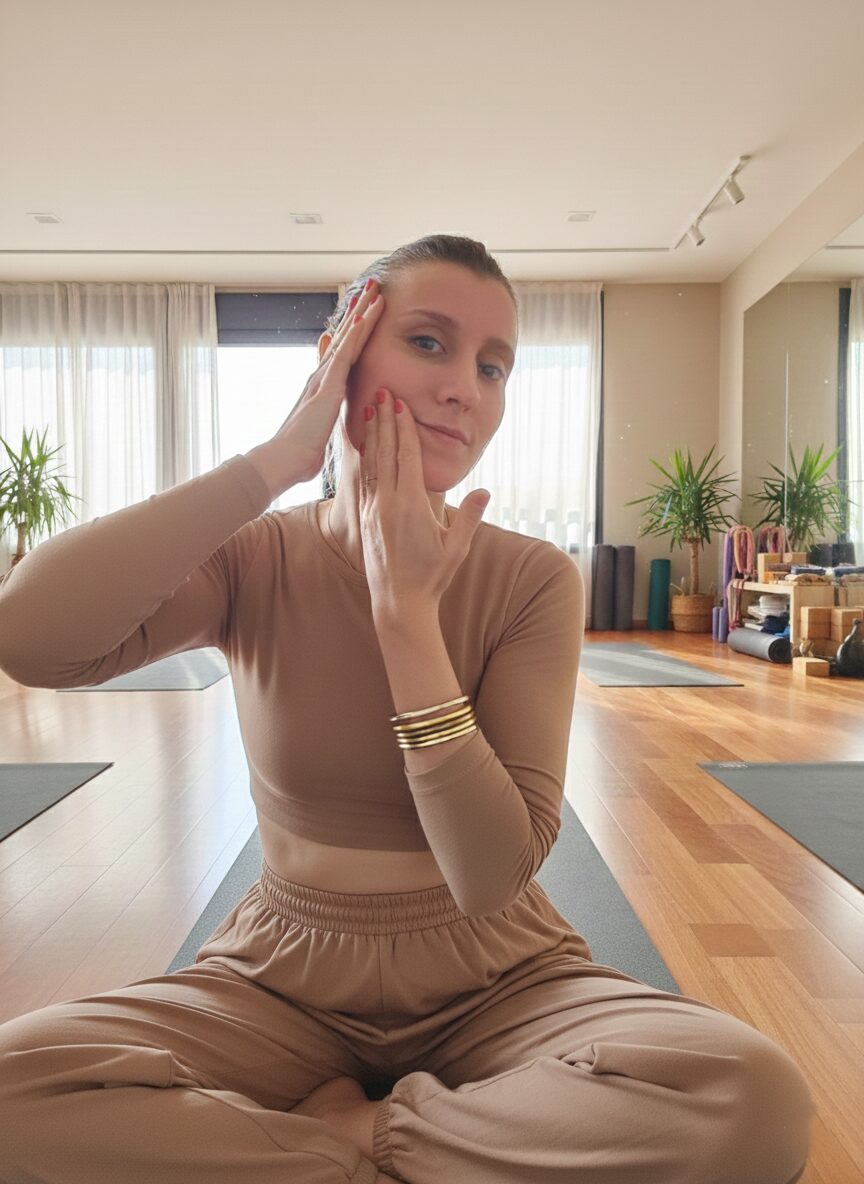
Understanding the different approaches to facial yoga is a first step. To work effectively, it is also essential to understand how wrinkles form and what is really happening within the tissues.
Wrinkles are part of the natural aging process. Over time, the skin changes, tissues evolve, and the face gradually transforms. But we do not all age in the same way. Some people develop a pronounced frown line, while others barely have one. Some notice their jawline progressively losing firmness, while others maintain more defined contours.
Why ?
The face is alive. It carries the imprint of our repeated expressions, our tensions, and the way certain muscles contract — often without us even realising it. As the skin loses elasticity with age, these repeated contractions gradually mark the tissues and certain wrinkles begin to appear.
The frown line, for example, often appears in people who frequently contract their eyebrows — while concentrating, thinking, or even during sleep when the muscle remains hypertonic. Over time, the muscle stays tense and the skin gradually marks that contraction.
But what I realised after testing many methods without success on my frown line is that the muscle is only part of the story.
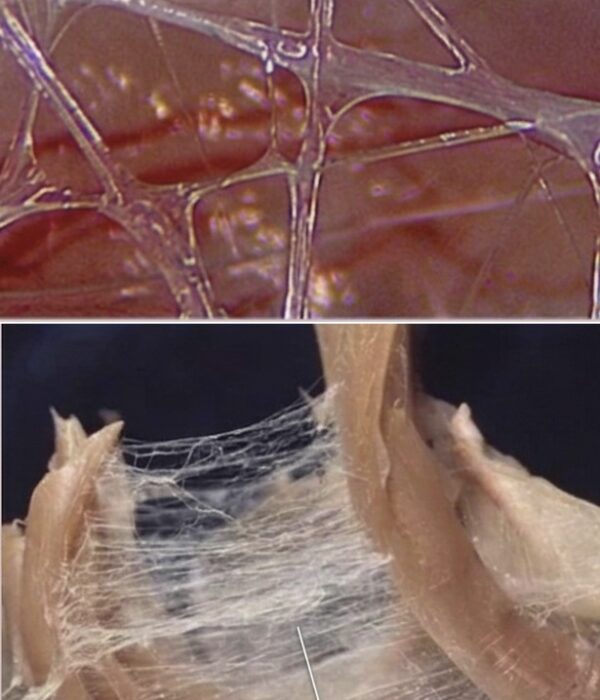
Beneath the skin lies a network of connective tissues called fascia. They surround the muscles, connect them together, and help maintain the structure of the face. When fascia loses mobility, it can keep tension locked deep within the tissues. You can massage a muscle, relax it, sculpt it… but if the surrounding fascia remains rigid, the tension tends to return.
That is exactly what I experienced.
What makes fascia particularly important is that it connects areas of the face we do not naturally associate together. Tension in the scalp can contribute to a frown line. Tension in the neck can also play a role in jawline sagging. The problem is not always located where the wrinkle appears.
It was by working more deeply on the fascia that I finally started to see real changes in my wrinkles.
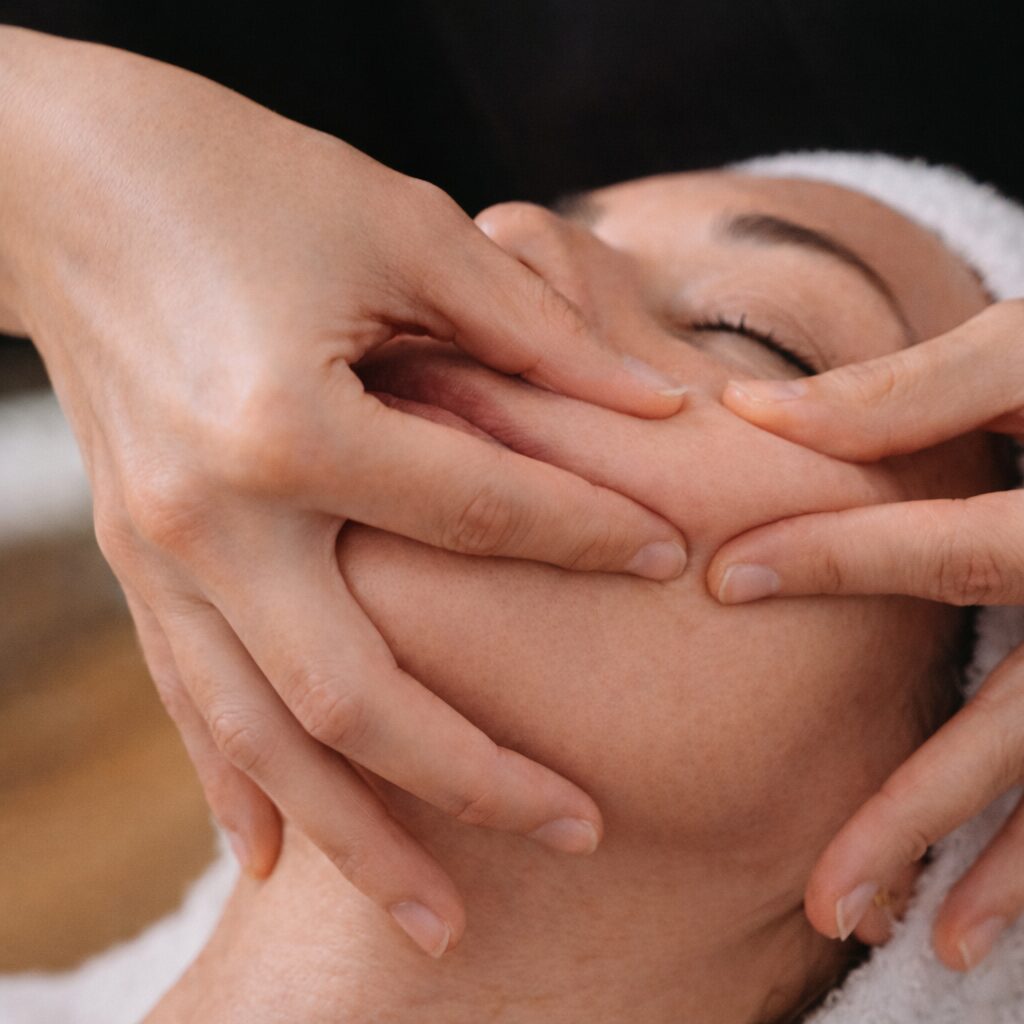
My approach is based on myofascial work on the face — a technique that acts on the fascia, the deeper connective tissues that hold tension in place. These accumulated tensions within the tissues contribute to the formation and persistence of wrinkles — in areas where traditional massage does not truly reach.
But working on the fascia is not enough if the work is not done in the right areas. A frown line may be maintained by tension in the scalp. Sagging along the jawline can be linked to tension in the neck. The cause is not always located where the wrinkle appears.
That is why my work always begins by understanding your face specifically — before any movement, protocol, or routine.
My role always begins by observing your face: where tension is located, how the tissues move, and which areas truly contribute to your wrinkles or loss of firmness.
Based on this assessment, I create a routine adapted to your face. Precise techniques for each area — but never applied in exactly the same way from one person to another. Depending on your face, some techniques will be prioritised while others may not be necessary. It is not the number of exercises that makes the difference, but the accuracy of the movements and their consistency.
Depending on the type of support you choose, you leave with movements to practise at home — a complete routine for the online programme, or more targeted exercises to complement an in-person session. Myofascial work relies on precise, slow and deep movements — learned once, practised for life.
My approach does not focus only on fascia. The skin, muscles, circulation and lifestyle are all closely connected. During the assessment, I also take these aspects into account to understand what may support or slow down results — and to create a routine that truly fits your daily life.

After more than ten years working in the cosmetics industry, an allergic reaction to a skincare product led me to question what I was putting on my skin. I started looking for healthier, more respectful products, and that is when I discovered Ringana. At first, I simply wanted to hydrate my skin with cleaner products, without imagining how much it would change things.
Over time, my skin rebalanced and my hormonal acne gradually disappeared. But as I approached my forties, certain wrinkles started to appear — especially my frown line. I did not want to resort to injections. By paralysing the muscle, injections may temporarily soften a wrinkle — but over time, a muscle that no longer contracts can lose tone, which may contribute to progressive sagging. I was looking for a natural approach that would genuinely act on my wrinkles without creating imbalance elsewhere.
Facial yoga then became the logical next step. I first practised on myself for more than a year, testing many different techniques. Some methods brought relaxation or brighter skin, but I did not see any real change in my wrinkles. Then I discovered deeper work on the fascia. It was the only approach that truly changed something in my face.
Seeing these changes made me want to go further. I decided to train more deeply in this approach so I could help other women, like me, soften their wrinkles naturally — without injections.
I support you in naturally smoothing wrinkles and releasing facial tension through myofascial facial work. This approach is based on precise techniques that you can learn to reproduce at home, with the right guidance. I also offer personalized sessions where I work directly on your face.

A first session to assess your face and identify areas of tension linked to your wrinkles.
You will leave with:
a clearer understanding of how tension affects your face
the priority areas to focus on
initial recommendations adapted to your needs.
Ideal if you want to better understand your face, discover myofascial facial work, and know where to begin.

Personalised guidance to learn the techniques adapted to your face and continue practising them at home.
We identify the areas to work on and the priorities, then I teach you the appropriate techniques so you can continue your practice independently.
Depending on your needs, you can choose a one-off session or an 8-week programme with personalised support over time.
Ideal if you want to learn how to work on your own face and incorporate this practice into your daily routine.

A session during which I work directly on your face to release tension and act more deeply on the areas involved in your wrinkles or loss of firmness.
Using precise and targeted myofascial techniques, I help restore mobility to the tissues, relax facial tension, and rebalance certain areas of the face.
Some effects can already be felt or seen from the first session.
For more lasting results, this approach is often combined with exercises to continue practicing at home between sessions.
Ideal if you would like direct hands-on work with a personalized and targeted approach.
I host online group sessions, each focused on a specific area of the face (forehead, jawline, neck, mouth area…).
During these sessions, we take the time to work deeply on one area through facial yoga exercises based on myofascial work. The goal is to release tension in the fascia, restore mobility in the tissues, and help the face regain a more relaxed and fluid appearance.
These sessions are also an opportunity to better understand why certain lines appear: which tensions or movement patterns are involved, how different areas of the face are connected, and how to adapt the techniques to your own face.
Whether you’re just starting or already practicing, these sessions help you work with precision, ask your questions, and build consistent habits over time.
Sessions are held in small groups to ensure a high-quality and personalized experience. New dates are released regularly. Sign up to get notified when the next session opens and receive all the details.
Discover how deep work on the fascia can help release these tensions and naturally soften wrinkles.
Not all faces age in the same way. In some people, expression lines become more pronounced. In others, the face tends to lose firmness and sag slightly, while some mainly develop fine lines. These different ways of aging give us clues about how facial tissues evolve over time.
In reality, one face often shows several of these characteristics at once. That is why my work does not consist only of identifying a type of aging, but above all of observing how the face has evolved and what tensions have developed over time.
Understanding this evolution allows us to look at wrinkles differently: not simply as marks on the skin, but as the expression of tensions or imbalances within the facial tissues.
Over time, the skin gradually loses elasticity and collagen. As a result, it marks more easily where repeated expressions occur: smiling, frowning, squinting… Wrinkles therefore become a natural part of how the face evolves with age.
But not everyone develops the same wrinkles, or in the same areas.
Why? Because every face keeps the imprint of repeated expressions and accumulated tension over the years. Some people constantly contract their forehead when concentrating, while others clench their jaw or tense certain parts of the face without even noticing it. Over time, these repeated contractions can leave deeper marks on the tissues.
Facial muscles are closely connected and surrounded by fascia — connective tissues that envelop and support the structures of the face. When tension settles in one area, it can maintain other parts of the face in a contracted state. A visible wrinkle therefore does not always mean the cause is located exactly where the wrinkle appears. A frown line, for example, may sometimes be maintained by tension located higher up, in the scalp.
Understanding what is really happening within the tissues makes it possible to act more precisely: releasing tension where it originates, restoring mobility to the fascia, and working on the areas that are truly involved rather than massaging only the wrinkle itself.

Frowning, squinting, smiling… These repeated movements place strong demands on certain facial muscles. Over time, when these muscles remain too contracted, the folds can become permanent, such as frown lines or crow’s feet.
But these tensions do not concern only the visible muscle. The fascia surrounding the muscles can also lose flexibility over time and keep the tissues in a contracted position.
That is why massaging only the muscle responsible for a wrinkle is not always enough. The tension can quickly return if the surrounding tissues remain restricted. The work therefore consists of releasing these tensions more deeply, at the level of the fascia, in order to restore mobility to the tissues and allow the muscle to relax more sustainably.

Over time, certain facial muscles gradually lose tone and support the tissues less effectively. The skin then becomes more affected by gravity.
This can appear as:
But this sagging is not only related to a loss of muscle tone. Tensions that develop in certain areas of the face or neck can also pull the tissues downward and accentuate this effect.
The work therefore involves restoring support to the face while also releasing these tensions. Working on the fascia helps restore tissue mobility and rebalance the areas of the face involved in this loss of firmness.
Discover the myofascial face yoga approach I use to work on the fascia and soften wrinkles over time. After testing many different methods, it is the only one that truly transformed the appearance of my own wrinkles.

In this guide, I share the key elements that support healthy, glowing skin: nutrition, movement, facial massage, skincare and stress management. A holistic approach to care for your skin every day.

I have selected a few essentials that I use to support facial work: simple tools and skin-friendly products. The hands do most of the work. Skincare supports the skin, and tools are used as a complement.
At what age can you start facial yoga?
Face yoga can be practiced at any age. Some people begin around 25–30 to prevent the appearance of the first wrinkles, while others start later to release tensions that have already developed or to accompany the natural changes of the face over time. The goal is not to stop the aging process, but to learn how to release tension and maintain tissue mobility.
When do you start seeing results with facial yoga?
This depends on each face, the tensions present, and how regularly you practice. Some people already feel their face more relaxed after a few sessions. For visible and more stable changes, it usually takes several weeks of regular practice.
Can facial yoga replace injections ?
Injections and facial work do not act in the same way. Injections smooth a wrinkle quickly by limiting muscle activity or filling a specific area. Face yoga and myofascial work act differently: they work on muscle tension, fascia mobility and tissue circulation. The goal is therefore different — to support the face naturally without freezing facial expressions.
How often should you practice facial yoga?
Regular practice is important, but that does not necessarily mean doing many exercises every day. In my approach, the goal is mainly to work on the areas that are actually concerned by tension, with a routine that is realistic and adapted. The areas are often alternated to give the tissues time to recover.
Can some facial yoga exercises make wrinkles worse?
Yes, it’s possible. Certain face yoga exercises, if not adapted or performed with too much tension, can reinforce contractions instead of releasing them. This is why it’s important to understand the origin of wrinkles and to work not only on the visible muscles but also on deeper tissues such as the fascia. I guide you step by step through adapted techniques that you can then reproduce at home. The goal is to help you become autonomous, with a simple and realistic routine.
Is working on fascia painful?
Myofascial work can sometimes feel a bit intense in areas where tension has been present for a long time, but it should never be painful. The techniques are progressive and adapted to each face. With practice, tissues gradually regain mobility and the work usually becomes more comfortable.
What if I already have significant sagging?
Even when sagging is already present, it is possible to improve facial tone and restore mobility in the tissues through myofascial work. The goal is not to completely transform the face, but to support its evolution by working on tension, muscle support and circulation.
Do I need tools like a gua sha?
Myofascial facial work is mainly performed with the hands. They allow you to feel the deeper tensions in the tissues and act precisely on the fascia. Some tools such as gua sha can be used as a complement for facial drainage, but they do not replace manual work when the goal is to release deeper tensions.
How does an online personalized session work?
During a session, we first start with a conversation to understand your face, your needs and your goals. I then guide you step by step through movements adapted to your face that you will be able to reproduce at home. The goal is to help you become autonomous with a simple and realistic routine.
Does facial yoga really work?
Facial yoga can help release tension and improve tissue mobility in the face. Like any body-based practice, results depend on consistency and how well the exercises are adapted to each individual. Some approaches mainly bring relaxation and glow, while more targeted work — especially on the fascia — can help act more deeply and sustainably on certain wrinkles.
What is the difference between the different facial yoga techniques ?
There are different approaches within face yoga. Some focus mainly on the skin or muscles through exercises and massage techniques. Myofascial face yoga works more deeply on the fascia, the connective tissues that surround muscles and link the structures of the face. When fascia loses mobility, it can maintain tension that contributes to the formation of wrinkles. Myofascial work aims to release these tensions and restore tissue mobility, acting more globally on the balance of the face.
Do you want to soften your wrinkles naturally?
Deep work on the fascia helps release facial tension and can truly soften wrinkles. If you would like to learn more about this approach, we can discuss it during a free consultation.
Be the first to receive the dates of upcoming online face yoga workshops, along with all the details to register.
Limited spots — small groups for high-quality guidance.

